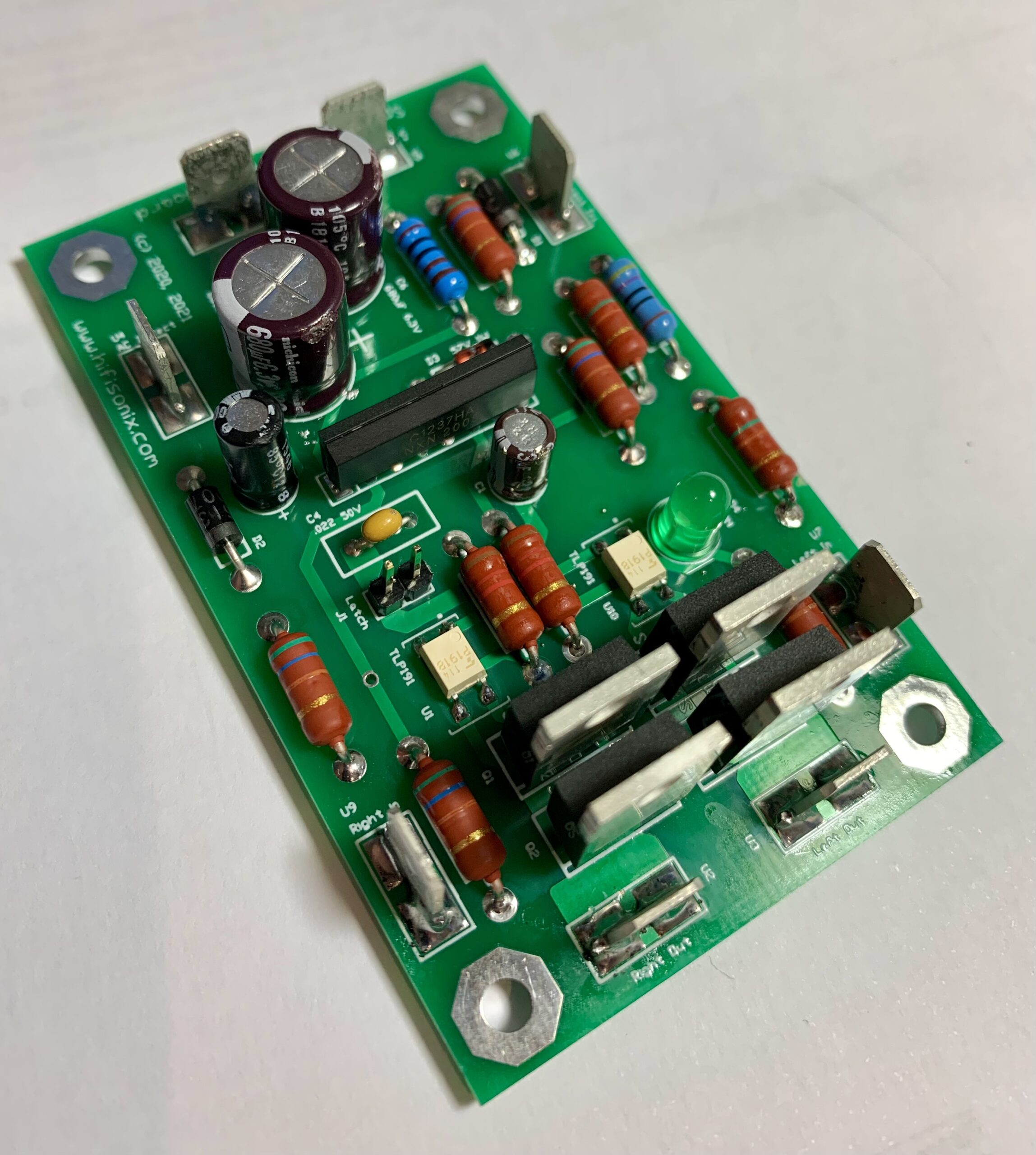
This simple, low-cost speaker protection board measuring just 82mm x 50mm uses the ubiquitous UPC1237 from Unisonic, a Taiwan based semiconductor manufacturer. The circuit will work from 25V through to 75V and uses mosfets to switch the speaker load rather than relays which are problematic and unreliable. A current overload input is also provided, allowing builders to arrange to sense an amplifier output short circuit and rapidly disconnect the amplifier output. The presentation below describes the operation and how to select resistor values for different supply voltages (updated April 2023).
ATTENTION: On some amplifiers, the turn on delay is not long enough to allow the amplifier to fully settle, and/or, the tolerance of C1 (33uF electrolytic) is not tight enough i.e. on +-20% types, the value can as low as 26uF. This may result in an audible sound because the output mosfet relays are energising too quickly. The recommended fix for this is to change C1 to 47uF or 56uF. The circuit will still operate successfully with values up to 100uF. Use 16V or higher voltage rating. Do NOT attempt to change the values of R3 or R5 to increase the delay as this leads to other problems, one of them being that the mosfets do not fully turn on which will almost certainly cause them to fail.
ATTENTION: If you are using the speaker protection board with the new nx2 amplifier, R7 must be changed to 33k. The reason for this is these amplifiers use a random phase opto-triac that switches the current protect output on the amplifiers to the +ve rail. The UPC1237 maximum current into the current trip input cannot exceed 3mA, otherwise the chip will be damaged.
Here is a short presentation on the use of mosfets for speaker switching in amplifiers


Leave a Reply